Form and function design — the conviction that how something works and how it looks are inseparable — used to be taken seriously. In February, I found myself wandering the upper floors of the Musée d’Orsay. Most visitors come for the Impressionists — and rightly so. But there is a section of the museum dedicated to Art Nouveau that tends to be quieter, almost meditative. Furniture by Gallé and Majorelle sits behind velvet ropes: wardrobes carved into flowering vines, chairs that look like they grew rather than were built. The objects are arresting not because they are beautiful — though they are — but because of what they represent: a conviction that the things we live with every day deserve the same creative ambition as a painting or a sculpture.
That belief, that design is not decoration but a form of thought made physical, stayed with me.
A few weeks later, I was browsing the website of a vintage furniture dealer when I stopped scrolling.
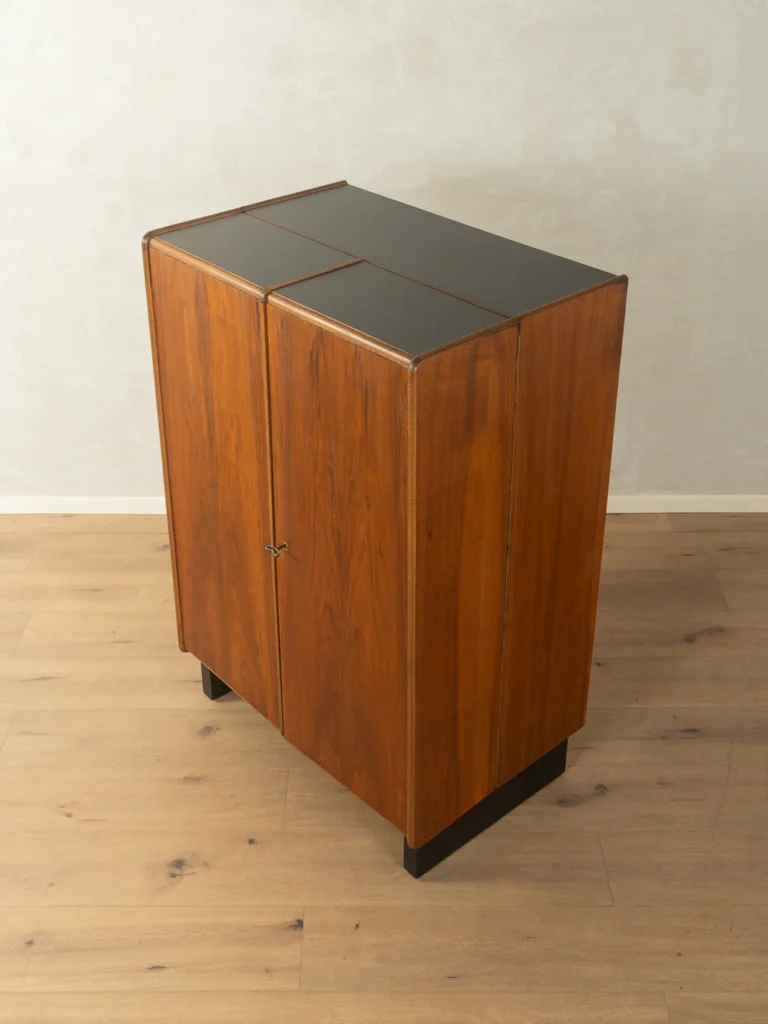
The piece I was looking at appeared, at first glance, to be a modest wardrobe. Walnut veneer, a black lacquered top surface, brass hardware at the center. Compact, almost understated. Nothing about its closed form would tell you much.
Then it opens.
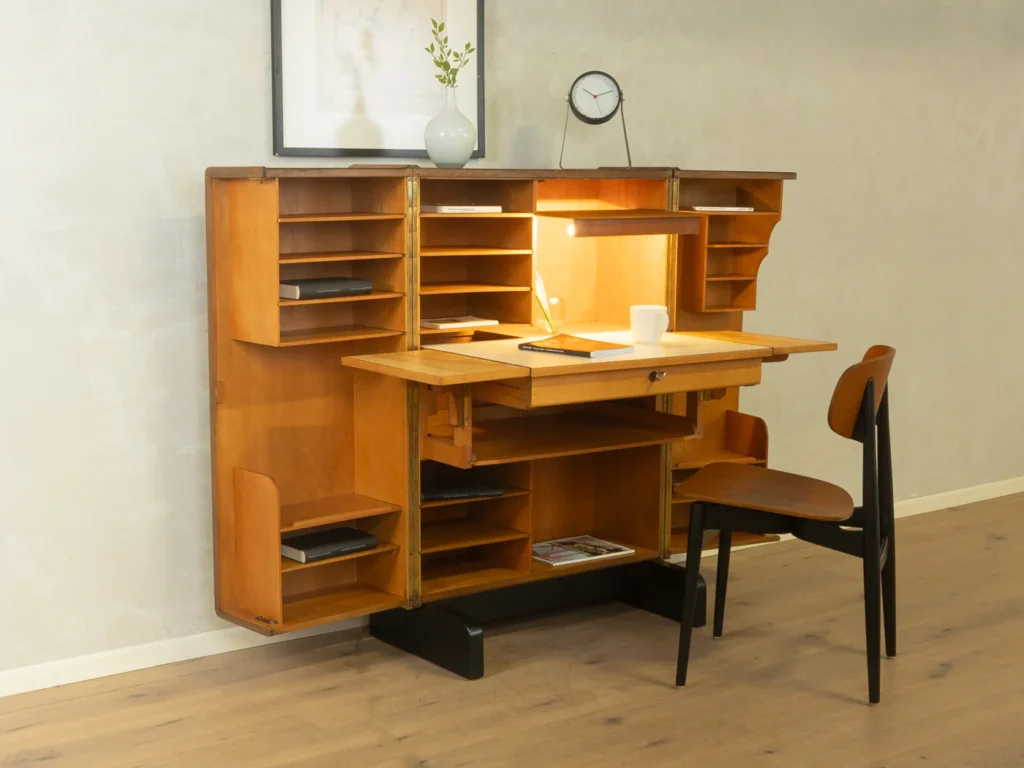
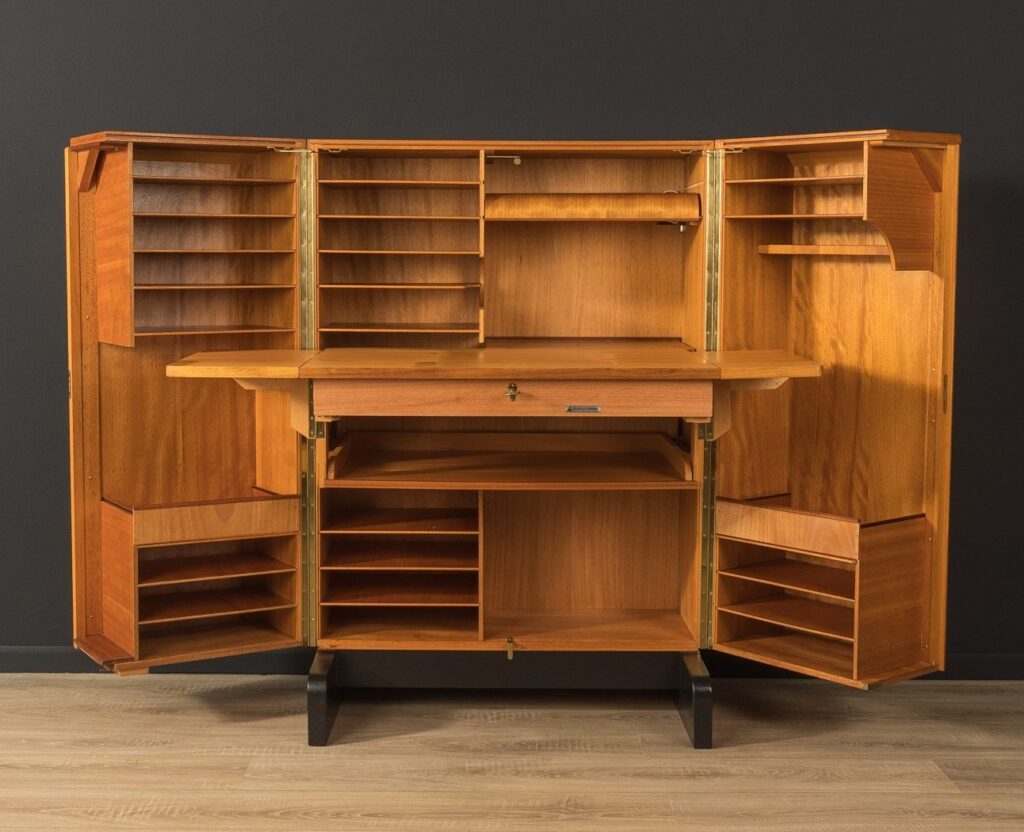
Four doors swing outward — two on each side — and what unfolds is something closer to a cockpit than a cabinet. A complete home office, engineered in wood. Dozens of shelves and letter trays in different configurations. A lockable drawer. A fold-out writing surface, supported by its own internal mechanism, wide enough to work at comfortably. Below it, document compartments and filing slots. In the upper center, an integrated lamp illuminates the entire interior. Every cubic centimeter has been considered. Every surface is doing something.
This is the Hausbuero — literally “home office” — by Schreibmayr Suisse, designed and manufactured in Switzerland in the 1960s. What it represents is form and function design taken to its logical conclusion.
What strikes me is not the cleverness of the engineering, though the engineering is remarkable. It is the underlying philosophy.
The Hausbuero was built for a world where work, correspondence, and domestic administration had a physical weight to them. Letters to be written, filed, retrieved. Bills to be organized. A document for every decision. The piece is a direct response to that reality: every category of paper has a home, every tool has its place, and when the day is done, it all disappears behind two doors. The room returns to the room.
There is a kind of thinking embedded in this object. The designer had to model, in advance, how a person works — what they reach for first, what needs to be near at hand, what can be tucked away — and then build that model in wood and brass. The result is not just a piece of furniture. It is a system. A philosophy of organized attention, given form.
We’ve largely abandoned this idea. Our offices are invisible now — a laptop, a cloud account, a tangle of notifications. The organization, such as it is, lives in software we didn’t design and can’t quite see. Nothing closes.
The thread between that quiet room at the Orsay and this Swiss cabinet is not obvious, but I think it’s real. Art Nouveau designers believed that a door handle, a staircase banister, a lamp base — the things your hands touch every day — deserved the same seriousness of intent as a canvas. The Hausbuero comes from a different tradition and a different decade, but it shares that conviction: that a well-designed object is not a neutral container for living, but an argument about how living should be done.
Both made me feel the same thing: a kind of admiration for people who thought this carefully about ordinary life, and a quiet frustration that we seem to have stopped asking the question.