Julia Margaret Cameron
1815–1879 · British · Wet collodionN° 02 · 2 of 4
Julia Margaret Cameron (1815–1879) was a British photographer, born in Calcutta, who made some of the most daring portraits of the Victorian era. She received her first camera at 48 and, in roughly twelve years, produced about 900 photographs: close, softly focused heads of eminent men, luminous studies of women, and staged scenes from poetry and scripture.
- Full name
- Julia Margaret Cameron (née Pattle)
- Born / died
- 11 June 1815, Calcutta, India; 26 January 1879, Kalutara, Ceylon (now Sri Lanka)
- Nationality
- British (born in India)
- Genre / movement
- Portraiture, allegorical and literary tableaux, Victorian art photography
- Active
- 1864–1875 (first camera received December 1863)
- Known for
- Close-up portraits of eminent Victorians, portraits of women, illustrations for Tennyson’s Idylls of the King
- Format / process
- Wet collodion glass negatives, albumen silver prints, large contact prints
Who was Julia Margaret Cameron?
Julia Margaret Cameron was a Victorian photographer who came to the medium late and changed it quickly. Born Julia Margaret Pattle in Calcutta in 1815, she was educated in France, married the jurist Charles Hay Cameron in 1838, and moved to England in 1845. In December 1863, while living at Freshwater on the Isle of Wight, she received a camera from her daughter and son-in-law. Within eighteen months she had sold eighty prints to the South Kensington Museum (today the V&A) and arranged for the London printseller Colnaghi to sell her work. Her career ended when she left for Ceylon in 1875.
Photography reached her early through a friendship. In 1836, at the Cape of Good Hope, she met the astronomer Sir John Herschel, who later wrote to her about the new inventions of William Henry Fox Talbot and Daguerre and, in 1842, sent her the first photographs she ever saw.
In London she moved through the salon of her sister Sara Prinsep at Little Holland House, where she met painters and poets who would later sit for her. In 1860 the family bought a house next to Alfred Tennyson’s at Freshwater and named it Dimbola, after one of their plantations in Ceylon.
She turned a coal house into a darkroom and a glazed chicken house into her studio. She had no training, and in her memoir Annals of My Glass House (written 1874) she admitted she did not know where to place her camera or how to focus her sitter. She never ran a commercial studio or took commissions, yet she copyrighted, exhibited, and sold her prints like a professional. She joined the Photographic Society of London in 1864 and held her first solo exhibition in November 1865.
What is Julia Margaret Cameron’s signature style?
Cameron’s style is recognizable at a glance: large heads filling the frame, soft or shifting focus, deep shadow, and light falling hard on one side of the face. She treated blur and movement as part of the picture, not as failure, and borrowed her lighting and poses from Italian painting rather than from commercial portrait studios.
Technically she worked with wet collodion on glass, a process that forced her to coat, expose, and develop each plate while it was still wet. Exposures lasted long enough for sitters to move, and she did not retouch the results. She printed on albumen paper, often at a size close to the plate, which gives her heads their startling scale.
Her portraits of men are built on chiaroscuro: dark clothing, dark background, one pool of light on the face and hair. Her portraits of women are gentler, with softer light and a more conventional distance. Her staged scenes cast family, friends, and servants as figures from the Bible, Shakespeare, Milton, and Tennyson.
The photographic press was hostile. Reviewing her 1865 submissions, The Photographic Journal credited her with “daring originality, but at the expense of all other photographic qualities.” Painters and writers saw it differently, and she won a gold medal in Berlin in 1866.
Julia Margaret Cameron’s most notable works and series
Cameron’s best-known works fall into three groups: close portraits of eminent men, portraits of women, and illustrated scenes from literature and scripture. The five below trace her short career from her first success in January 1864 to her last major project, the Idylls of the King volumes of 1874 and 1875.
Annie, “My First Success” (1864)
On 29 January 1864 Cameron photographed Annie Philpot, the young daughter of a family staying on the Isle of Wight, within weeks of receiving her camera. She called it her first success and printed, toned, and framed it herself the same day. The soft focus and the tousled, windblown look of the portrait already announce everything that followed.
View the photograph ↗Annie, 1864. Albumen print from wet collodion glass negative. Victoria and Albert Museum, London.The Mountain Nymph Sweet Liberty (1866)
A model known only as Miss Keene stares straight into the lens, hair loose, head filling the frame. The title comes from Milton’s L’Allegro. When Cameron sent a print to Herschel, he replied that the sitter seemed to thrust her head out of the paper, and called it her own special style.

Sir John Herschel (1867)
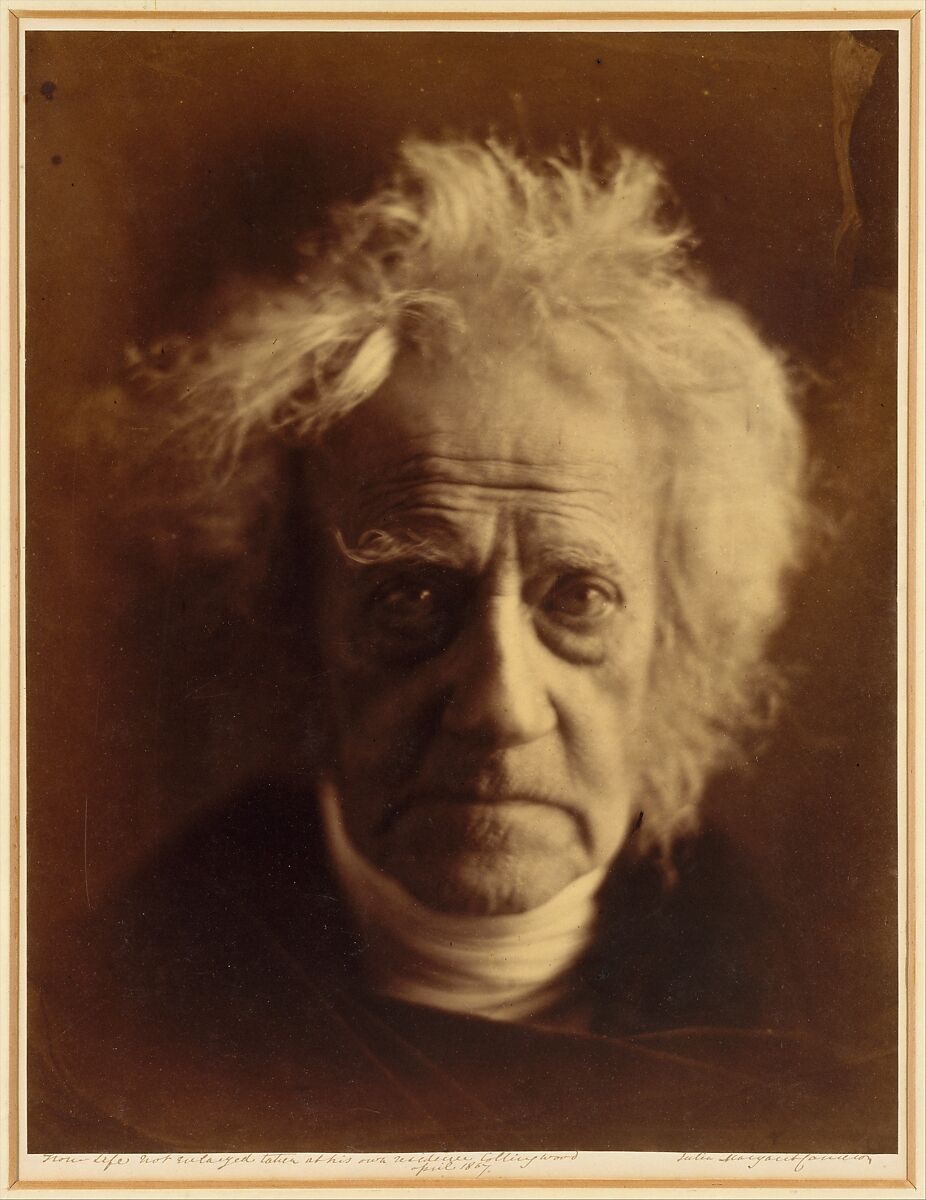
Cameron had known Herschel for thirty years when he sat for her in April 1867. She had him wash and tousle his hair to catch the light, draped him in black, and moved the camera close to his face. No props, no columns, no books: just a head emerging from darkness. The Met notes that no commercial portraitist of the period would have shown him this way.
Julia Jackson (1867)
Cameron made more than twenty portraits of her niece and goddaughter Julia Jackson, always as herself, never costumed as a saint or a sibyl. In this 1867 print the 21-year-old seems to float without a body. Julia Jackson later became the mother of Virginia Woolf and Vanessa Bell, and Woolf drew on her for Mrs. Ramsay in To the Lighthouse.

Idylls of the King: Vivien and Merlin (1874)
In 1874 Tennyson asked Cameron to illustrate a new edition of his Arthurian poems. Unhappy with how small her images appeared in print, she issued her own volumes of large original photographs in 1874 and 1875. She made about 180 exposures for the project, posing family and friends as Tennyson’s characters. It was her last large-scale work.

Why should you care about Julia Margaret Cameron?
Cameron proved that a portrait could aim at character rather than likeness. The historian Colin Ford has called her portraits arguably the first close-ups in photography, and her refusal of sharp, studio-style finish put her at the center of the early debate over photography as art. Critics who dismissed her staged scenes, from George Bernard Shaw to Roger Fry, still praised her portraits of men such as Herschel and Carlyle.
Recognition came in waves. The South Kensington Museum held the first museum exhibition of her work in 1865 and, in 1868, gave her two rooms as a portrait studio, which the V&A describes as perhaps making her its first artist-in-residence.
After her death her reputation faded. In 1926 Virginia Woolf and Roger Fry published Victorian Photographs of Famous Men and Fair Women, the first major collection of her work, and in 1948 Helmut Gernsheim’s monograph revived serious interest.
Modern scholarship followed. In 2003 the J. Paul Getty Museum published Julia Margaret Cameron: The Complete Photographs by Julian Cox and Colin Ford. The Metropolitan Museum of Art held a retrospective in 2013–2014, the V&A marked her bicentenary in 2015–2016, and the Morgan Library & Museum showed Arresting Beauty in 2025. She was inducted into the International Photography Hall of Fame in 2019, and her former home, Dimbola on the Isle of Wight, is now a museum run by the Julia Margaret Cameron Trust.
I photograph landscapes, not faces, but Cameron is the photographer who made me stop apologizing for softness. Her critics wanted every hair sharp. She wanted the sitter’s presence, and she was willing to sacrifice definition to get it. The Herschel portrait works because almost everything is left in darkness and only what matters receives light.
That is a lesson for black and white landscape work too: decide what the picture is about, then let the rest fall away. Where I part ways with her is the costume dramas. Her allegorical tableaux feel of their time, while her plain portraits feel timeless. The strongest images are the ones where she trusted light and a face, and nothing else.