Gustave Le Gray
1820–1884 · French · Waxed-paper negativeN° 03 · 3 of 4
Gustave Le Gray (1820–1884) was a French photographer and the central figure of French photography in the 1850s. Trained as a painter, he refined the waxed-paper negative, photographed France’s monuments for the 1851 Mission héliographique, and made seascapes printed from two negatives that won him international acclaim.
- Full name
- Jean-Baptiste Gustave Le Gray
- Born / died
- 30 August 1820, Villiers-le-Bel, France; 30 July 1884, Cairo, Egypt
- Nationality
- French
- Genre / movement
- Early art photography: landscape, seascape, architecture, portraiture
- Active
- Late 1840s–1884 (first daguerreotypes by 1847)
- Known for
- The waxed-paper negative, the Mission héliographique (1851), seascapes of 1856–1858
- Format / process
- Waxed-paper negatives and salted paper prints; from the mid-1850s, glass negatives and albumen silver prints
Who was Gustave Le Gray?
Gustave Le Gray was a painter turned photographer who shaped French photography in its first decades. The only child of a haberdasher, he was born in 1820 at Villiers-le-Bel, near Paris, and studied painting in the studio of Paul Delaroche. He made his first daguerreotypes by 1847 and began experimenting with paper negatives in 1848. His first treatise, published in 1850, described a variation of William Henry Fox Talbot’s process in which the paper negative was waxed before sensitization, giving a crisper image. By 1851 he was one of the five photographers chosen for the Mission héliographique, and a founder of the Société héliographique.
He was also a teacher. Around fifty of his students are known, among them Charles Nègre, Henri Le Secq, Nadar, and Maxime Du Camp. In the fall of 1855 he founded Gustave Le Gray et Cie and opened a lavish portrait studio at 35 boulevard des Capucines in Paris, and he became a photographer to Napoleon III.
The studio’s debts caught up with him. The company was dissolved on 1 February 1860, and Le Gray left his family and fled France to escape his creditors. He sailed from Marseille with Alexandre Dumas in May 1860, photographed Garibaldi and Palermo, and was left behind in Malta after a quarrel with Dumas. He went on to Lebanon and finally Egypt, where he settled in Cairo, taught drawing, and kept photographing. He never returned to France and died in Cairo in 1884.
What is Gustave Le Gray’s signature style?
Le Gray’s style is painterly ambition carried out through technical control. His pictures are built on large masses of light and shadow, low horizons, and wide skies, printed at a scale that was large for the time. He wanted photography, in his own words from 1852, to be “included among the arts,” and composed like a painter to get there.
His early work used waxed-paper negatives and salted paper prints, which give soft, matte tonality. From the mid-1850s he moved to glass negatives and albumen silver prints, with finer detail and warmer, glossier tones.
The seascapes show his key invention. Photographic emulsions of the time were not equally sensitive to all colors, so a single exposure could not hold both a bright sky and a darker sea. Le Gray often printed two negatives on one sheet, one exposed for the sea and one for the sky, sometimes made on different occasions or in different places, and joined them at the horizon. The result looks like one moment of light, but it is a constructed image.
Gustave Le Gray’s most notable works and series
Le Gray’s most important work falls into five groups: the forest studies at Fontainebleau, his 1851 Mission héliographique, the seascapes of 1856 to 1858, his work for Napoleon III’s court, and the photographs made after he left France in 1860.
Forest of Fontainebleau (1849–1856)
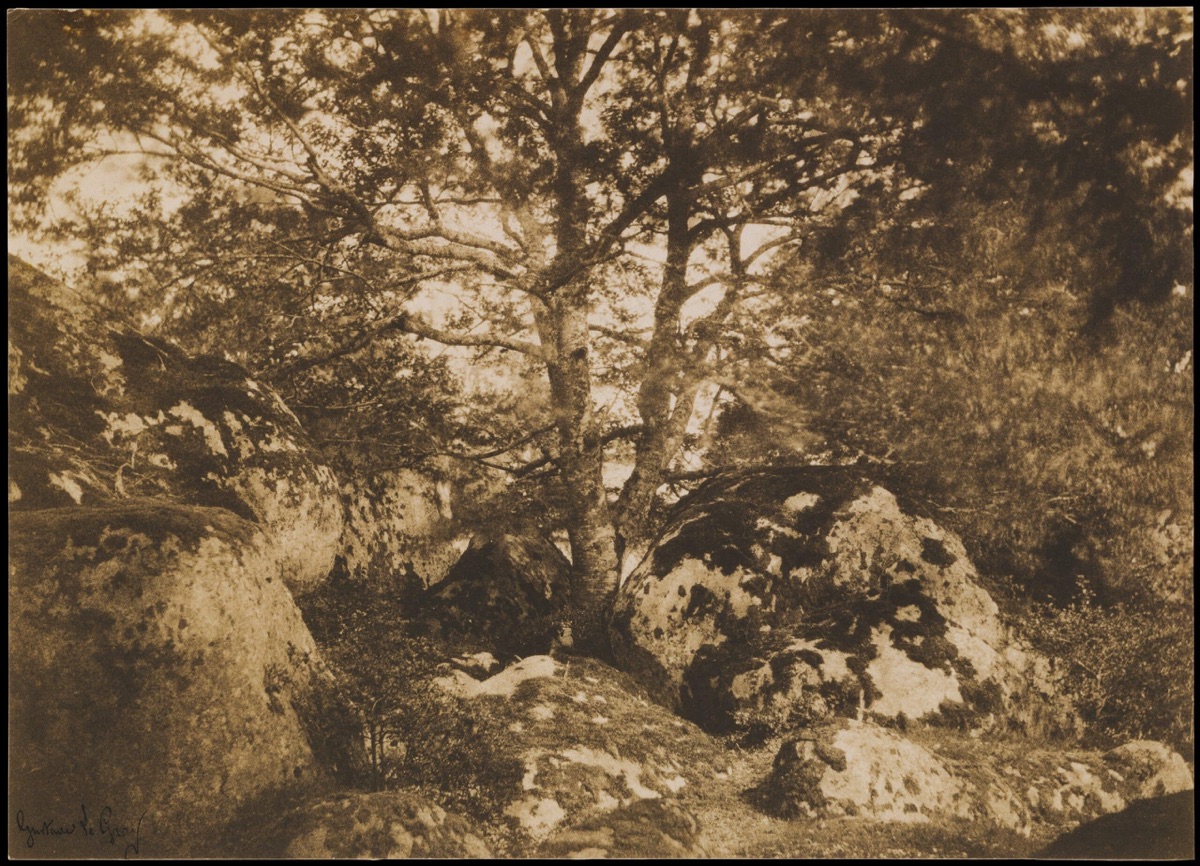
Le Gray followed the Barbizon painters into Fontainebleau Forest and made it one of his first great subjects. His early views, on paper negatives, helped build his reputation before the Mission héliographique. He returned around 1856 with glass negatives, producing some of his most admired tree studies.
Mission héliographique (1851)
In 1851 the French government’s Commission des Monuments historiques sent five photographers to record the country’s historic architecture. Le Gray’s route ran through the southwest: the châteaux of the Loire, churches on the pilgrimage road to Santiago de Compostela, and the medieval walls of Carcassonne before their restoration. He traveled with Auguste Mestral, sometimes photographing sites on Mestral’s list and sometimes working jointly with him.
View the photograph ↗The Ramparts of Carcassonne, 1851, Gustave Le Gray and Auguste Mestral. Salted paper print from waxed paper negative. The Metropolitan Museum of Art.Seascapes (1856–1858)
The seascapes, made on the Channel and Mediterranean coasts of France, are Le Gray’s most celebrated work. Pictures such as The Great Wave, Sète (1857) and Mediterranean with Mount Agde (1857) combine sky and sea from separate negatives. They caused a sensation and brought him international recognition; one 1857 review reported 50,000 francs in orders for the seascapes.

Photographs for Napoleon III’s court (1856–1857)
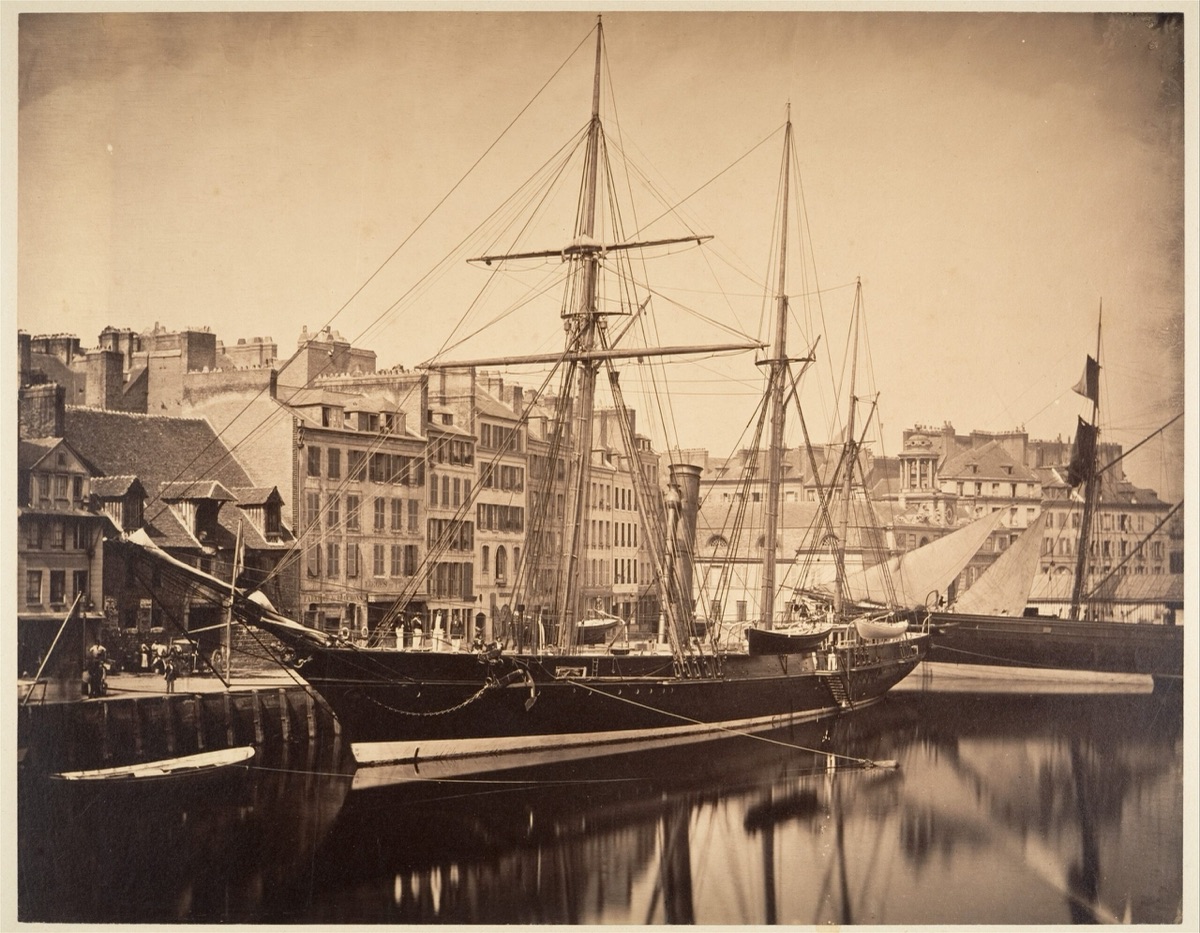
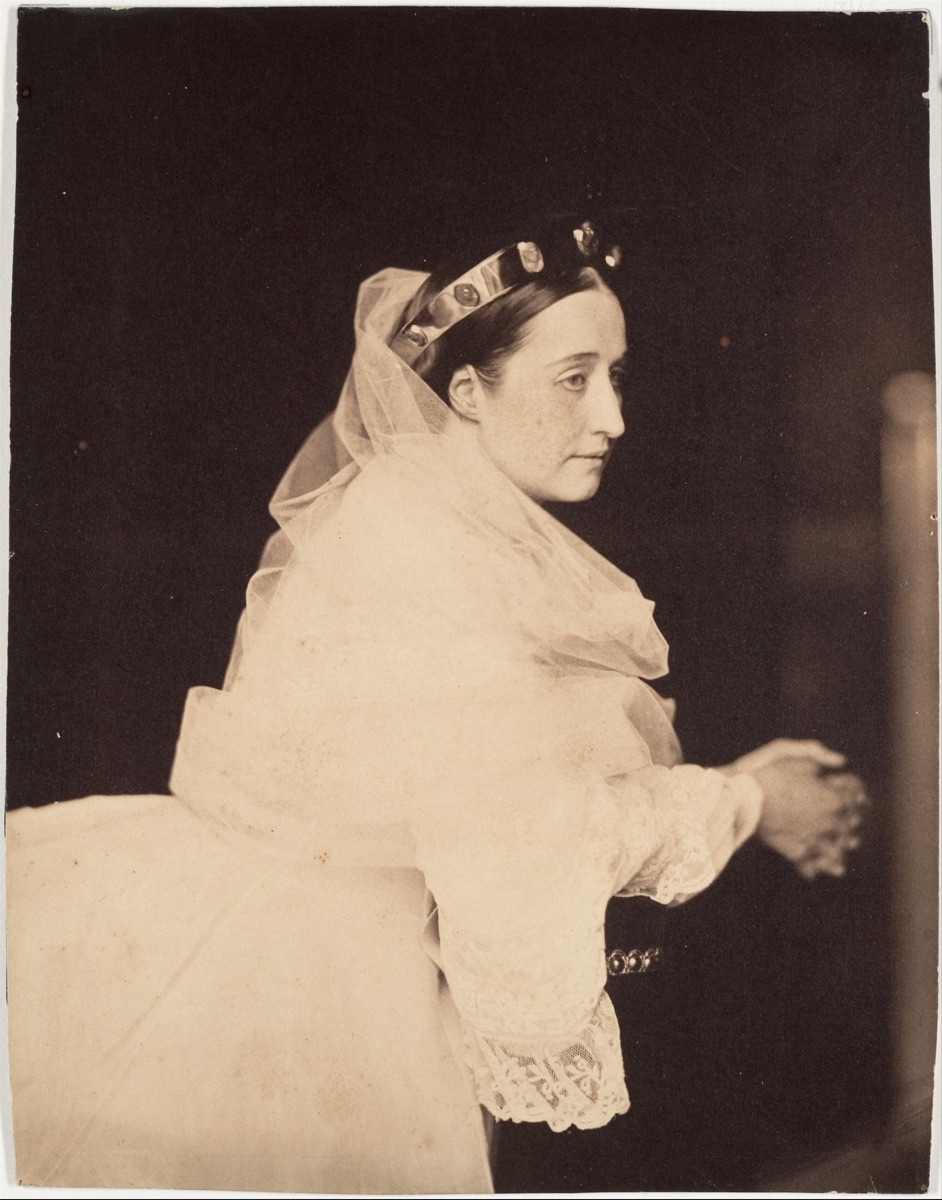
As a photographer to the emperor, Le Gray portrayed the imperial family and its world. In 1856 he photographed the imperial yacht La Reine Hortense at Le Havre and the Empress Eugénie at prayer, and in 1857 he documented the military camp at Châlons for Napoleon III.
The Mediterranean and Egypt (1860–1884)
After fleeing France, Le Gray photographed Garibaldi and the barricaded streets of Palermo in 1860, then worked in Lebanon and Egypt. In Cairo he earned his living teaching drawing, including to the sons of the pasha, while continuing to photograph monuments such as the Temple of Edfu. Relatively few works survive from these last two decades.
View the photograph ↗Temple of Edfu, 1867. Albumen silver print from paper negative. The Metropolitan Museum of Art.Why should you care about Gustave Le Gray?
Gustave Le Gray argued, in print and in pictures, that photography belonged among the fine arts. He improved the paper negative, trained a generation of French photographers, and solved the sky-and-sea exposure problem with combination printing. Today his seascapes are among the most valued photographs of the nineteenth century.
His prints were collected early. In 1868 the collector Chauncy Hare Townshend gave a group of his seascapes to the South Kensington Museum, today’s Victoria and Albert Museum. After his death his name faded, and modern scholarship rebuilt it: the Art Institute of Chicago published Eugenia Parry Janis’s The Photography of Gustave Le Gray in 1987, and the J. Paul Getty Museum held the exhibition Gustave Le Gray, Photographer in 2002, with a catalogue by Sylvie Aubenas.
The market followed. In October 1999 a print of The Great Wave, Sète sold at Sotheby’s in London for £507,500, then a world record for a photograph at auction.
Le Gray taught me that tonal subtlety is where photography’s power lies. The way he rendered light on water, how he let skies breathe without going flat, the discipline of his compositions: these are lessons I return to in every print. What strikes me most is that his seascapes are constructed, two negatives joined at the horizon, yet they read as a single moment. That is the honest truth of fine-art printing: the image is made, not just taken.
Where I differ is in tone. His albumen prints sit in warm browns, and I prefer the austere neutrality of true black and white. But the principle is the same: the photograph must hold the viewer in contemplation.