Eugène Atget
1857–1927 · French · Albumen printsN° 04 · 4 of 4
Eugène Atget (1857–1927) was a French photographer who spent three decades recording the streets, shopfronts, courtyards, and parks of Paris before modernization swept them away. Working alone with an old-fashioned view camera and glass plates, he made about 10,000 photographs that he sold as “documents for artists” and that later shaped modern documentary photography.
- Full name
- Jean-Eugène-Auguste Atget
- Born / died
- 12 February 1857, Libourne, France; 4 August 1927, Paris, France
- Nationality
- French
- Genre / movement
- Documentary photography; adopted by the Surrealists as a forerunner
- Active
- 1888–1927 (professional photographer in Paris from 1890)
- Known for
- Old Paris; the Petits Métiers street trades; shop windows; the parks of Versailles, Saint-Cloud, and Sceaux
- Format / process
- Wooden bellows view camera, 18 × 24 cm glass plate negatives, contact prints on albumen and gelatin printing-out papers
Who was Eugène Atget?
Eugène Atget was an actor turned photographer who became the great visual archivist of old Paris. Born in Libourne, near Bordeaux, in 1857, he was orphaned at seven, raised by his grandparents in Bordeaux, and went to sea in the merchant navy. He moved to Paris in 1878, studied drama, and toured the suburbs and provinces with a traveling company. An infection of his vocal cords ended his acting in 1887. He made his first photographs in 1888, in Amiens and Beauvais, and by 1890 was back in Paris selling pictures to painters, architects, and stage designers. A sign at his door read “Documents pour artistes.”
From 1898, Paris institutions became his main clients. The Musée Carnavalet and the Bibliothèque historique de la ville de Paris bought his prints, and the library commissioned him around 1906 to photograph the city’s old buildings systematically. In 1899 he settled at 17 bis rue Campagne-Première in Montparnasse with his companion, the actress Valentine Delafosse Compagnon.
He was far less obscure than his later legend suggests. His address book, now at the Museum of Modern Art, lists about 460 clients, from architects and decorators to publishers and painters such as Georges Braque, Maurice de Vlaminck, and Tsuguharu Foujita.
During World War I he stored his negatives in his basement and almost stopped photographing. In 1920–21 he sold thousands of negatives to institutions; one sale alone covered 2,600 negatives for 10,000 francs. In a November 1920 letter to Paul Léon, the senior French fine-arts official, he summed up two decades of work in one line: “I can say that I possess all of Old Paris.”
In his last years he turned to the former royal parks around the city. Valentine died in 1926, and Atget died in Paris on 4 August 1927.
What is Eugène Atget’s signature style?
Atget’s style is patient, frontal, and quietly strange. He kept a nineteenth-century view camera long after faster equipment existed, framed streets at an angle to show buildings in their setting, and favored soft light and empty scenes. Slow plates blurred anything that moved, which leaves many pictures feeling hushed, as if the city had paused for him.
Eugène Atget’s camera was a large-format wooden bellows camera with a rapid rectilinear lens, loaded with 18 × 24 cm glass plates of the Bande Bleue brand. The emulsion was slow, so exposures were long and passersby often appear as blurs.
The dark corners in many of his prints are not a defect. Atget shifted the lens relative to the plate to control perspective and keep vertical lines straight, which pushed the edge of the lens’s coverage into the frame and caused vignetting.
Eugène Atget never used an enlarger. Every print is a contact print the size of its negative, exposed in sunlight on printing-out paper (albumen, gelatin, or, after World War I, matte albumen papers), then gold toned. He also scratched each negative number into the emulsion, which is why small reversed digits appear in the corners of so many of his pictures.
Above all, he thought in series. By the end of his career he was working on thirteen at once, among them Picturesque Paris, Art in Old Paris, Environs, Interiors, Saint-Cloud, Versailles, and Sceaux, often returning to a subject after years away.
Eugène Atget’s most notable works and series
Eugène Atget’s best-known photographs come from five strands of his work: the Petits Métiers street trades of 1898–1899, the long Old Paris project, the 1912 eclipse picture the Surrealists made famous, the shop windows of the 1920s, and the late park series at Saint-Cloud. Every image below is in the public domain.
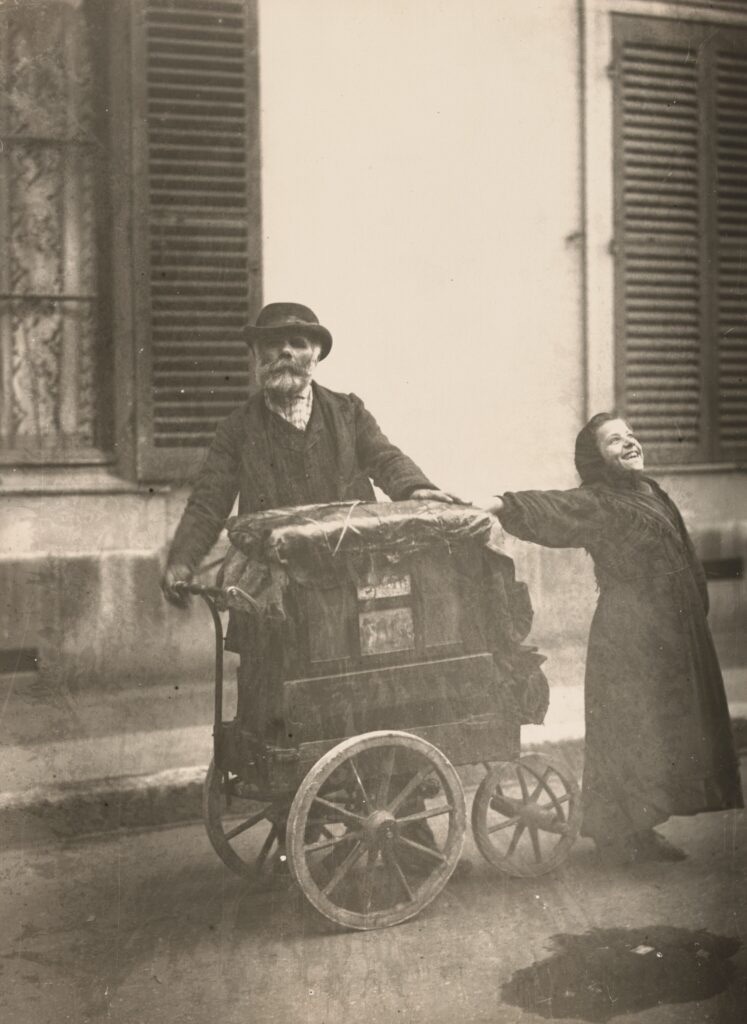
Petits Métiers: Joueur d’orgue (1898–1899)
Among his earliest Paris work is a series on the city’s small trades: pavers, lampshade sellers, saw sharpeners, and street musicians. Most sitters pose as types. The Organ Grinder breaks the pattern: a man at his barrel organ and a woman singing beside him, caught in performance. The Met calls it the masterpiece of the series, and its own print was bought from Atget in the 1920s by the painter Maurice Utrillo.
Old Paris: Rue Saint-Rustique (1922)
Old Paris was Eugène Atget’s life project: the architecture and streets that predated the French Revolution, many of them marked for demolition. He avoided flat architectural elevations and instead framed winding streets so that buildings stood in their context. This view of rue Saint-Rustique in Montmartre dates from 1922, more than twenty years into the inventory.

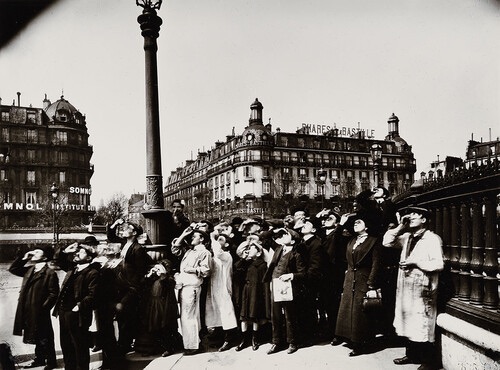
L’Éclipse, Place de la Bastille (1912)
On 17 April 1912 a crowd gathered at the foot of the July Column to watch a solar eclipse through viewing devices and even their own fingers. Atget turned his camera on the spectators, not the sky. In June 1926 Man Ray put the picture on the cover of La Révolution surréaliste no. 7, retitled Les Dernières Conversions. Atget asked not to be credited, telling Man Ray these were simply documents he made.
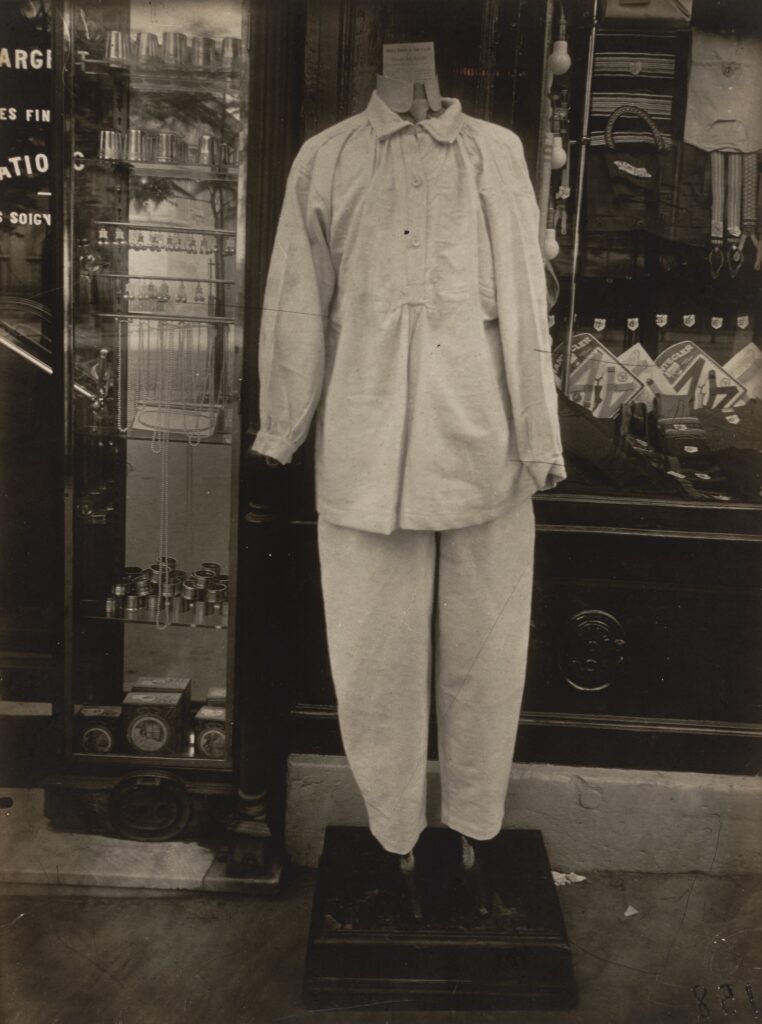
Shop windows: Avenue des Gobelins (1925–1927)
In his last years Eugène Atget photographed shop windows on the avenue des Gobelins, where mannequins, merchandise, and reflections of the street merge on the glass. The Met reads this headless mannequin in a white uniform as a modern version of Gilles, the clown painted by Watteau. Pictures where inside and outside dissolve into each other are a large part of why the Surrealists embraced him.
Saint-Cloud (1926)
In the 1920s Eugène Atget returned again and again to the former royal park at Saint-Cloud, west of Paris, photographing its trees, pools, statues, and allées. He sometimes recorded the hour: MoMA titles one print “9 h. 2 avril 1926.” Here a great tree, a statue, and still water fade toward a misty horizon. These are among the last pictures he made.

Why should you care about Eugène Atget?
Eugène Atget showed that a methodical record of ordinary places could become art. His archive preserves a Paris that has largely disappeared, and his direct, unsentimental way of seeing passed through Berenice Abbott and Walker Evans into the core of twentieth-century documentary photography, all while he insisted he only made documents.
Recognition of Eugène Atget began just before his death. Berenice Abbott, then working for Man Ray, met him in 1925 and photographed him in 1927. After he died, his friend and executor André Calmettes gave about 2,000 negatives of historic Paris to the French state and sold the rest to Abbott, who later partnered with the New York dealer Julien Levy.
In 1929 eleven of his photographs hung in the Film und Foto exhibition in Stuttgart. Abbott published Atget, photographe de Paris in 1930, a portfolio of 20 prints from his negatives in 1956, and The World of Atget in 1964. In 1931 Walter Benjamin’s essay Kleine Geschichte der Photographie cast him as a forerunner of Surrealist photography.
In 1968 the Museum of Modern Art bought the Abbott and Levy collection: 1,415 glass negatives and nearly 8,000 prints. John Szarkowski and Maria Morris Hambourg then produced The Work of Atget, four exhibitions and four volumes between 1981 and 1985. The Philadelphia Museum of Art acquired Julien Levy’s collection, including 361 Atget photographs, in 2001. The Bibliothèque nationale de France held a retrospective in 2007, and the Musée Carnavalet showed 230 of his prints in 2012. A crater on Mercury bears his name.
Eugène Atget is the photographer I think of when I stand in a forest at first light and wait. He went back to Saint-Cloud season after season, sometimes writing the hour on his prints, because a place only reveals itself over time and in a particular light. That patience, more than any technique, is what I carry from him into my own black and white landscape work.
His equipment makes a point that is easy to forget with a modern camera. He used one slow, heavy view camera for decades and never chased new gear. The constraint shaped the work: long exposures, empty streets, stillness. Mist and slow plates did for him what I try to do with fog and a long tonal range, which is to strip a scene down to structure and atmosphere.
Where I part ways is his insistence that these were only documents. I understand the modesty, and perhaps the business logic, but his Saint-Cloud trees are not records. They are acts of attention, as deliberate as any fine-art print, and I would rather say so openly.